“Think. Act. Observe. Repeat – the cycle powering every agent you’ve heard of.”
If you strip away all the frameworks, libraries, and buzzwords, almost every agentic AI system is running the same simple loop underneath. Understanding this loop is the single most valuable thing you can learn about agentic AI – everything else is a variation on this idea.
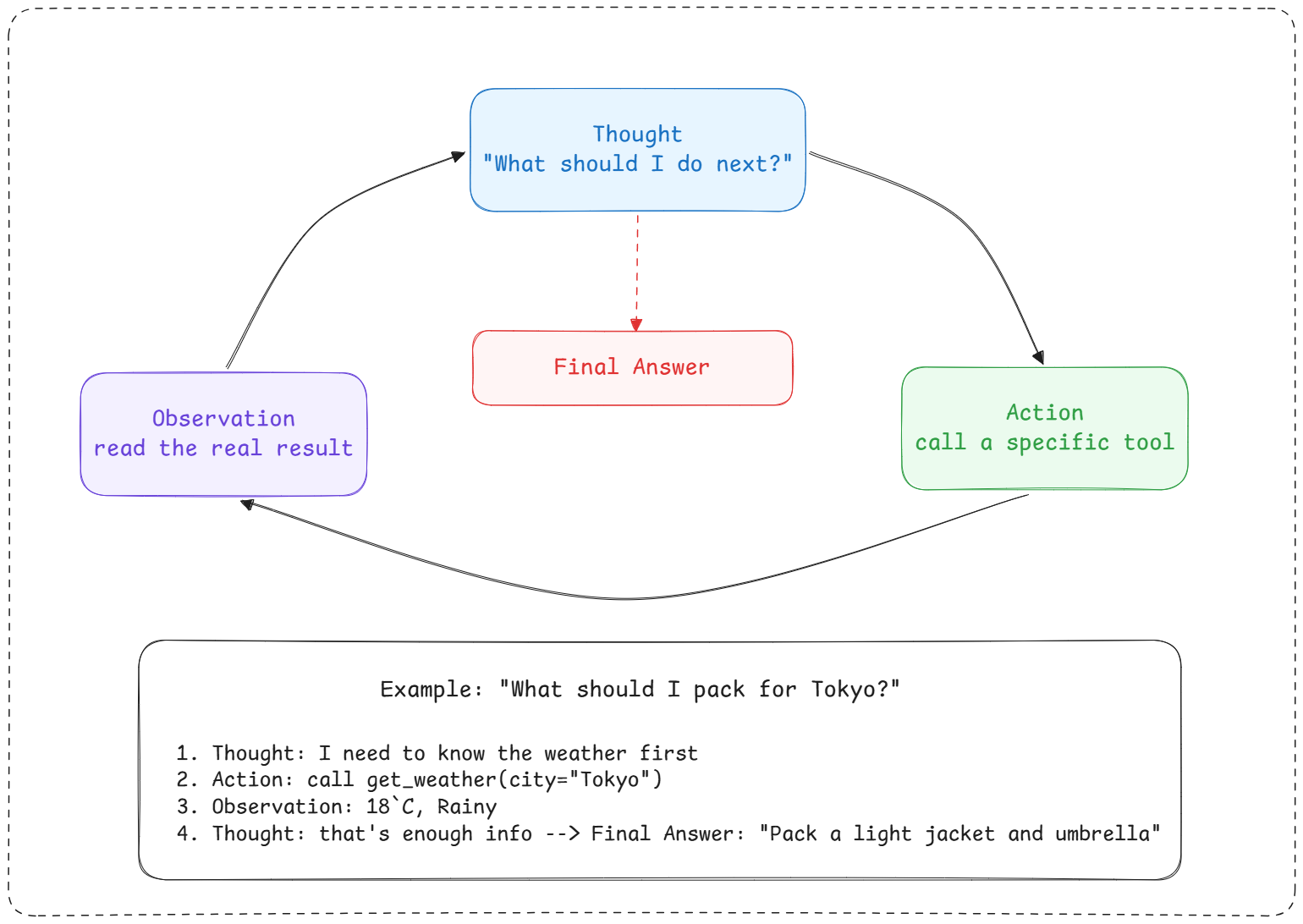
It’s usually called the ReAct loop (short for Reason + Act), and it looks like this:
The three steps, one at a time
1. Thought – The model looks at the goal and everything that’s happened so far, and reasons about what to do next. This might be phrased explicitly (“The user wants the weather in Tokyo, so I should call the weather tool”) or it might happen implicitly inside the model’s response.
2. Action – The model picks a specific tool and specific inputs for it. This is the moment where “reasoning in language” turns into “an actual instruction the system can execute” — like get_weather(city="Tokyo").
3. Observation – The system actually runs that action and feeds the result back to the model. Maybe the weather tool returns {"temp": 18, "condition": "rainy"}.
Then the loop repeats. The model looks at this new information and decides: is the task done, or is there another step? If the user asked “what should I pack for Tokyo,” the model now needs another thought (“it’s rainy and 18°C, so I should recommend a light jacket and umbrella”) before it can give a final answer.
Why a loop, and not a single step?
Because most real tasks can’t be solved in one shot. Consider: “What’s the total cost if I buy 3 of the cheapest laptop on this website, plus 15% tax?”
That single request actually requires:
- Search the website for laptops
- Identify the cheapest one
- Multiply the price by 3
- Calculate 15% tax on that
- Add it up and report the total
A regular chatbot might try to do all this in its head and get the math wrong, or hallucinate a price. An agent using the loop does each step for real — searching, then calculating precisely with a tool — checking its work as it goes.
Knowing when to stop
The trickiest part of the loop isn’t the thinking or the acting — it’s knowing when you’re done. An agent needs a way to recognize “I have everything I need to answer now” versus “I still need another step.” This is usually handled by having the model output something distinct for a final answer (versus a tool call), so the surrounding code knows to exit the loop and hand control back to the human.
This is also where things can go wrong. An agent might:
- Stop too early, giving an incomplete answer
- Loop too long, repeating similar actions without making progress (this is why most agent frameworks include a maximum step count as a safety net)
- Misjudge a result, treating a failed tool call as if it succeeded
Good agent design spends a lot of effort on these edge cases — not just the happy path where everything works.
A loop is simple; a good loop is not
The beauty of the ReAct loop is how simple it is to describe. The challenge in building real agents is everything that makes the loop reliable: handling errors gracefully, avoiding redundant tool calls, keeping the context from growing unmanageably large over many steps, and giving the model enough information at each step to make a good decision without overwhelming it.
We’ve talked about the “Action” step somewhat abstractly so far — just “the model picks a tool.” Let’s make that concrete. In the next post, we’ll look at exactly how tool use / function calling works under the hood.
Next up: Tool Use: Giving Agents Hands →
Comments (...)
You must be signed in to join the discussion.