“From answering questions to actually getting things done.”
If you’ve used ChatGPT or Claude, you already know what a chatbot does: you ask a question, it answers. You ask a follow-up, it answers again. It’s a conversation — smart, fast, sometimes startlingly insightful — but fundamentally reactive. It waits for you to talk, then talks back.
Agentic AI is different. An agent doesn’t just answer. It acts.
Tell a chatbot “book me a flight to Tokyo next month” and it’ll explain how you might go about it. Tell an agent the same thing, and it will actually check calendars, search flights, compare prices, and come back with “I found three options — want me to book the cheapest one?” It didn’t wait for step-by-step instructions. It figured out the steps itself.
The core difference: a loop, not a single response
A chatbot’s job ends the moment it finishes typing a reply. An agent’s job isn’t done until the task is done — and that might take five steps, or fifty, with the agent deciding what to do next at each one.
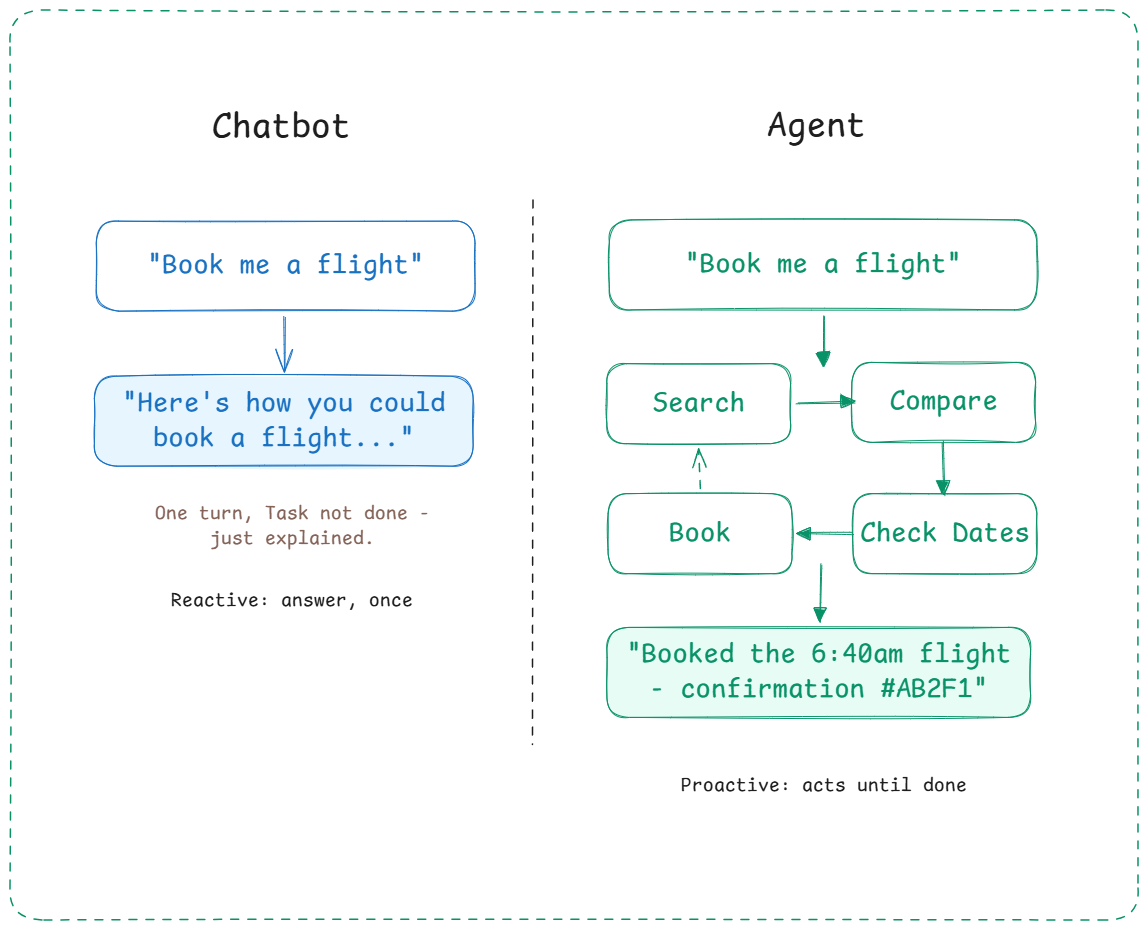
Think of the difference like ordering at a restaurant versus hiring a personal assistant:
- A chatbot is a waiter. You ask for something specific; they bring it. Ask for something else; they bring that too. Every interaction is one request, one response.
- An agent is an assistant. You say “handle my travel for the conference,” and they figure out the flights, the hotel, the calendar conflicts, and only come back to you when they need a decision only you can make (like “aisle or window seat?”).
What makes this possible?
Three ingredients, layered on top of a regular LLM:
- Tools — the ability to do things, not just talk. Search the web, run code, query a database, send an email.
- Planning — the ability to break a big goal into smaller steps, and decide what order to do them in.
- Memory — the ability to keep track of what’s happened so far, so step 12 can still remember what was learned in step 2.
None of these are new inventions on their own. What’s new is combining them with a large language model as the “reasoning engine” that decides, at each step, what to do next. That’s the whole trick — and it’s why the field has exploded so quickly. You’re not teaching a model a new skill; you’re giving an existing skill (reasoning in language) a body it can use to interact with the world.
Why this matters right now
For decades, software has needed a human to specify exactly what to do, in what order, for every scenario. Agentic AI flips that. You describe the goal, and the system works out a reasonable path to it — adapting on the fly when something doesn’t go as planned (a flight is sold out, a webpage doesn’t load, an API returns an error).
This is genuinely new territory for software, and it’s also messier than traditional programming. Agents can get stuck in loops, misjudge a step, or confidently do the wrong thing. Part of what makes this field exciting — and part of what makes it hard — is that we’re still learning how to build agents that are reliable, not just impressive in a demo.
What’s coming in this series
Over the next five posts, we’ll open up the hood and look at exactly how agents work:
- Post 2: The building blocks inside every agent — the “brain,” the “hands,” and the “memory”
- Post 3: The agent loop — the repeating cycle of thinking, acting, and observing that powers everything
- Post 4: Tool use in detail — how an LLM actually calls a function and gets a result back
- Post 5: Memory and RAG — how agents remember things beyond what fits in a single conversation
- Post 6: Multi-agent systems — what happens when agents start working with other agents
By the end, you won’t just know what agentic AI is — you’ll understand how to think about building one yourself.
Next up: Inside an Agent: The Building Blocks →
Comments (...)
You must be signed in to join the discussion.