The technology that’s revolutionizing how we build, ship, and run applications
Picture this: You’ve just finished building an amazing web application on your laptop. It works perfectly in your development environment. But when you try to deploy it to production, everything breaks. The server has a different operating system, different library versions, and missing dependencies. Sound familiar?
This scenario has plagued developers for decades, leading to the infamous phrase “But it works on my machine!” Docker solved this problem so elegantly that it fundamentally changed how we think about application deployment.
What Exactly Is Docker?
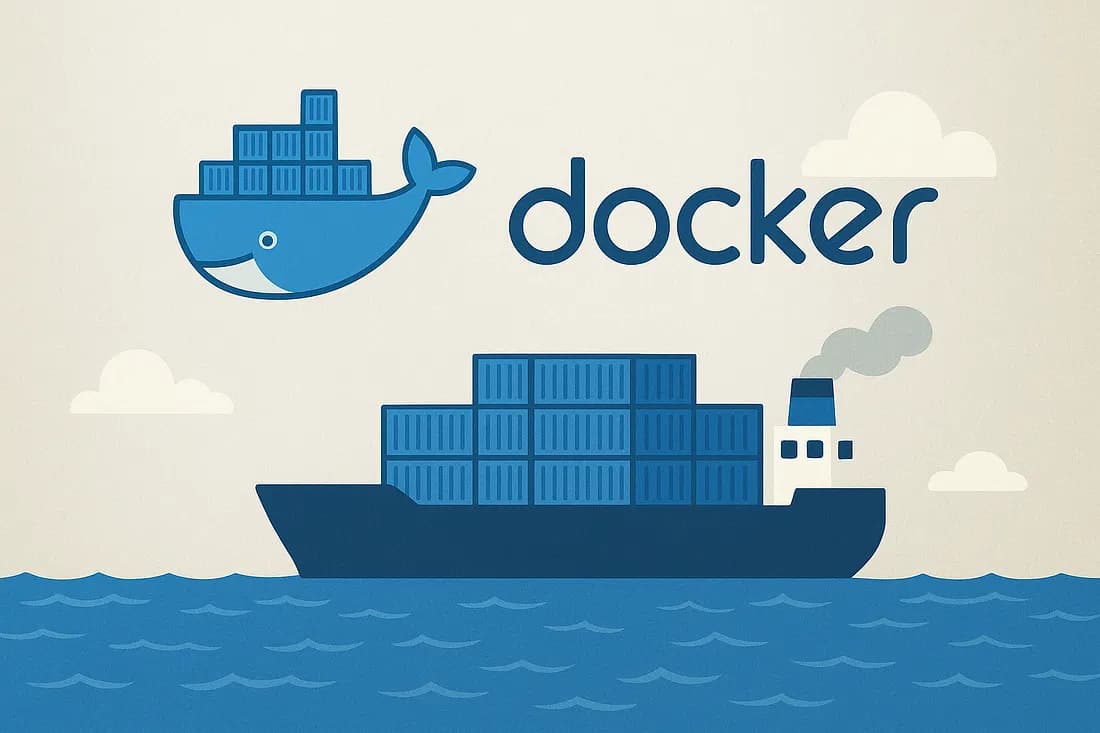
Docker is a containerization platform that packages your application and all its dependencies into a lightweight, portable container. Think of it as a shipping container for your code — just like how shipping containers revolutionized global trade by standardizing how goods are packaged and transported, Docker containers standardize how applications are packaged and deployed.
But what does that mean in practical terms?
A Simple Analogy
Imagine you’re moving to a new apartment. You could throw all your belongings loose into a moving truck (like traditional deployment), hoping everything arrives intact and fits properly in your new space. Or you could pack everything into standardized boxes with clear labels, ensuring your belongings are protected and can be easily moved anywhere.
Docker containers are like those standardized moving boxes for your applications.
Containers vs. Virtual Machines: What’s the Difference?
Before Docker, if you wanted to isolate applications, you’d typically use virtual machines (VMs). Here’s how they compare:
Virtual Machines:
- Include a full operating system
- Require significant resources (CPU, memory, storage)
- Take minutes to start up
- Heavy isolation, but with overhead
Docker Containers:
- Share the host operating system kernel
- Lightweight and efficient
- Start in seconds
- Process-level isolation with minimal overhead
Think of VMs as separate houses on a street-each with its foundation, utilities, and infrastructure. Containers are more like apartments in a building — they share common infrastructure but remain completely separate and secure.
Why Docker Became a Game-Changer
1. Consistency Across Environments
Your application runs identically on your laptop, staging server, and production environment. No more “works on my machine” problems.
2. Simplified Deployment
Deploy anywhere Docker runs — cloud providers, on-premises servers, or even IoT devices: one container, multiple destinations.
3. Resource Efficiency
Run multiple containers on the same hardware with minimal overhead. You can pack more applications into the same server compared to VMs.
4. Faster Development Cycles
Developers can quickly spin up complex environments with multiple services using simple commands. No more spending hours setting up databases, message queues, and dependencies.
5. Microservices Made Practical
Docker makes it feasible to break monolithic applications into smaller, manageable services that can be developed, deployed, and scaled independently.
Real-World Impact: The Numbers Don’t Lie
Since Docker’s introduction in 2013, adoption has been explosive:
- Over 13 million developers use Docker
- More than 13 billion container image downloads per month
- 85% of IT decision-makers use containers in production
- Companies report 50% faster deployment times on average
Docker in Action: A Quick Preview
Here’s what Docker looks like in practice. Don’t worry about understanding every detail yet — we’ll cover this thoroughly in upcoming posts.
In just two commands, you’ve downloaded and started a production-ready web server. No installation, no configuration files, no dependency conflicts.
Who Should Care About Docker?
Developers: Eliminate environment inconsistencies and focus on writing code instead of managing infrastructure.
DevOps Engineers: Standardize deployment processes and improve system reliability.
System Administrators: Maximize server utilization and simplify application management.
Startups: Move fast without getting bogged down in infrastructure complexity.
Enterprise Teams: Modernize legacy applications and improve development velocity.
Common Misconceptions Debunked
“Docker is just for web applications.” False. Docker containerizes any application — databases, machine learning models, desktop apps, batch jobs, and more.
“Docker is only for Linux.” Not anymore. Docker runs natively on Windows and macOS, though Linux containers remain the most common.
“Docker replaces VMs entirely.” Not exactly. They solve different problems and often work together. Many organizations run Docker containers inside VMs.
“Docker is too complex for a small project.” Docker often simplifies small projects by eliminating the complexity of setup.
Ready to Get Started?
Docker isn’t just a tool — it’s a fundamental shift in how we think about application deployment and infrastructure. Whether you’re a solo developer or part of a large enterprise team, understanding Docker is becoming as essential as knowing Git or your favorite programming language.
The “but it works on my machine” era is over. The age of consistent, portable, efficient application deployment is here.
Coming up next: We’ll get Docker installed on your system and run your first container. No theory, just hands-on practice that will have you up and running in minutes.
What’s your biggest deployment headache today? Share it in the comments — chances are Docker can help solve it, and we might feature your use case in an upcoming post!


Comments (...)
You must be signed in to join the discussion.